How Much Boat Paint Do I Need? A Practical Calculation
2026 guide series · Editorial timeline: May 10, 2026. First published October 27, 2026.
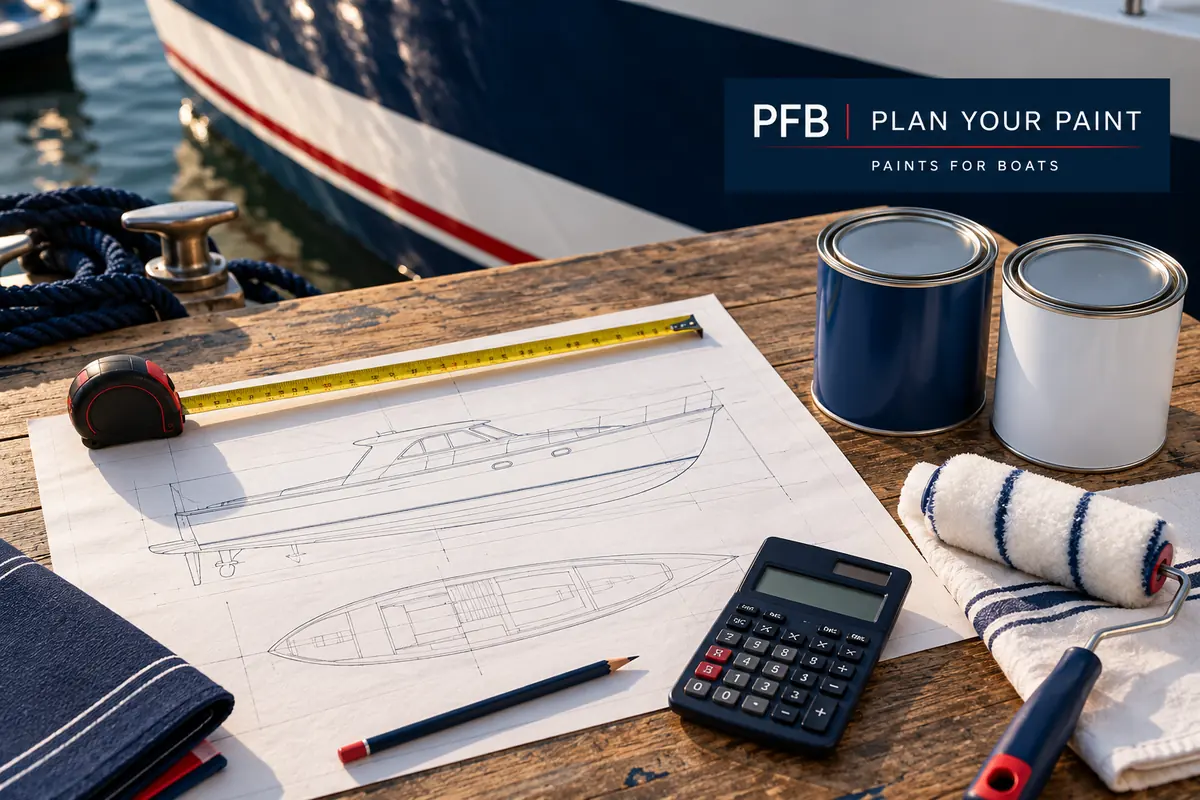
To work out how much boat paint you need, measure the area you will coat, multiply by the required number of coats, divide by the coating's stated coverage, and allow for application losses. Calculate primer and finish paint separately, then round each total to available container sizes.
Boat length is useful for an initial budget, but two boats of the same length can have different freeboard, transoms, cabins, and painting boundaries. A measured project list is more useful than a universal gallons-per-foot rule.
Define the surfaces before doing the math
Write down exactly what the job includes: both topsides, the transom, a cabin side, or selected repairs. Keep decks and underwater surfaces on separate lines. They may need different coating systems and quantities.
If you are unsure where your finish paint belongs, start with topside paint versus bottom paint. Quantity calculations do not establish suitability for immersion.
For an accessible topside, divide the surface into manageable sections and record each section's length and average height. Add both sides and the transom. Measure along the actual surface where practical, rather than assuming the boat's advertised length describes every painted panel. TotalBoat also describes dividing hull surfaces into smaller measured sections as an alternative to a broad hull approximation. Source: TotalBoat topside paint calculator.
Keep a sketch with the measurements. Mark excluded windows, fittings, stripes, and large openings. Avoid spending time subtracting every tiny fitting while ignoring a broad flare or an entire transom.
Read coverage in the right units
Find the selected product's technical data sheet and record:
- Coverage per gallon or quart, including the specified film thickness.
- Required coats or total film build for your application.
- Whether coverage is theoretical or practical.
- Container sizes and any mixing requirements.
A coverage figure is not a promise that one container will complete the entire project. For example, TotalBoat lists Wet Edge at 350–400 square feet per gallon at its specified wet-film thickness and separately specifies its coat count. Those figures describe that product, not every marine enamel. Source: TotalBoat Wet Edge specifications.
When comparing PFB Pro Marine Enamel and PFB Marine Enamel Standard Gloss, confirm the current technical sheet for the actual product being supplied. Do not transfer another manufacturer's coverage, thinner, or coat schedule to either product.
Use one formula for each coating
Gallons before package rounding = area in square feet × coats ÷ coverage in square feet per gallon × allowance factor.
An allowance factor of 1.15 means adding 15% to the calculated coating quantity. It is a planning assumption, not a universal manufacturer requirement. Rollers, trays, intricate surfaces, and spraying can change actual losses. TotalBoat's own calculator guidance includes an extra allowance and rounds quantities to container units. Source: TotalBoat quantity guidance.
Check whether your chosen coverage figure already includes losses before adding another allowance. For a two-part system, also check whether coverage refers to the mixed kit; do not count the hardener as a second purchase of usable paint.
A hypothetical topside calculation
The following numbers are assumptions for illustrating the method, not a coating specification or a measured boat recommendation.
| Assumed measurement or specification | Example value |
|---|---|
| Port topside | 22 ft × 3 ft = 66 sq ft |
| Starboard topside | 22 ft × 3 ft = 66 sq ft |
| Transom | 8 ft × 3 ft = 24 sq ft |
| Total paintable area | 156 sq ft |
| Primer schedule | 1 coat at 350 sq ft/gal |
| Topcoat schedule | 3 coats at 400 sq ft/gal |
| Added allowance | 15% |
Primer: 156 × 1 ÷ 350 × 1.15 = 0.513 gallon. If that primer is supplied only in one-gallon containers, purchase 1 gallon.
Topcoat: 156 × 3 ÷ 400 × 1.15 = 1.346 gallons. If that finish is supplied only in one-gallon containers, purchase 2 gallons.
The example purchase is therefore 1 gallon of primer plus 2 gallons of topcoat. The products cannot be combined into a single interchangeable paint total. If the actual primer instructions instead require two full coats, the primer calculation becomes 1.025 gallons, which rounds to two one-gallon containers.
Available quarts could reduce leftover material. Compare package combinations after calculating the full requirement, rather than rounding each individual coat upward and multiplying those rounded purchases.
Check the plan before ordering
Use our boat paint estimator for an initial planning estimate. Check its output against your measured surfaces and the selected product's technical sheet; an estimator does not confirm coating compatibility, immersion suitability, or a complete primer schedule.
Before checkout, confirm the final color, package size, and intended coating system. Keep your measurements and arithmetic with the order. For the work sequence, see how to paint a boat hull; use the marine primer guide to identify the primer questions to resolve before buying.
Frequently asked questions
How much paint do I need for a 24-foot boat?
Length alone cannot determine paint quantity. Measure the surfaces being painted, then calculate each coating using its coverage rate, required coats, and an allowance for application losses.
Does a coverage rate include every coat?
Usually the stated spreading rate describes one coat at a specified film thickness. Check the technical data sheet and multiply the area by the required coat count before dividing by coverage.
Should primer and topcoat be calculated separately?
Yes. Primer and topcoat can have different spreading rates, coat counts, and areas of application. Calculate and round each product separately.
Can thinner make a gallon cover more boat?
Do not count thinner as extra coating coverage. Use only the manufacturer's permitted thinner and amount, and maintain the specified film thickness.
Manufacturer sources
Need to know how much paint to buy?
Start with your boat dimensions, then check coverage and coats against the selected coating's technical sheet.
Use the Paint Calculator →